SaaS buyout multiples fall to 11.7x from 20.4x on $58.8bn of sponsor deals
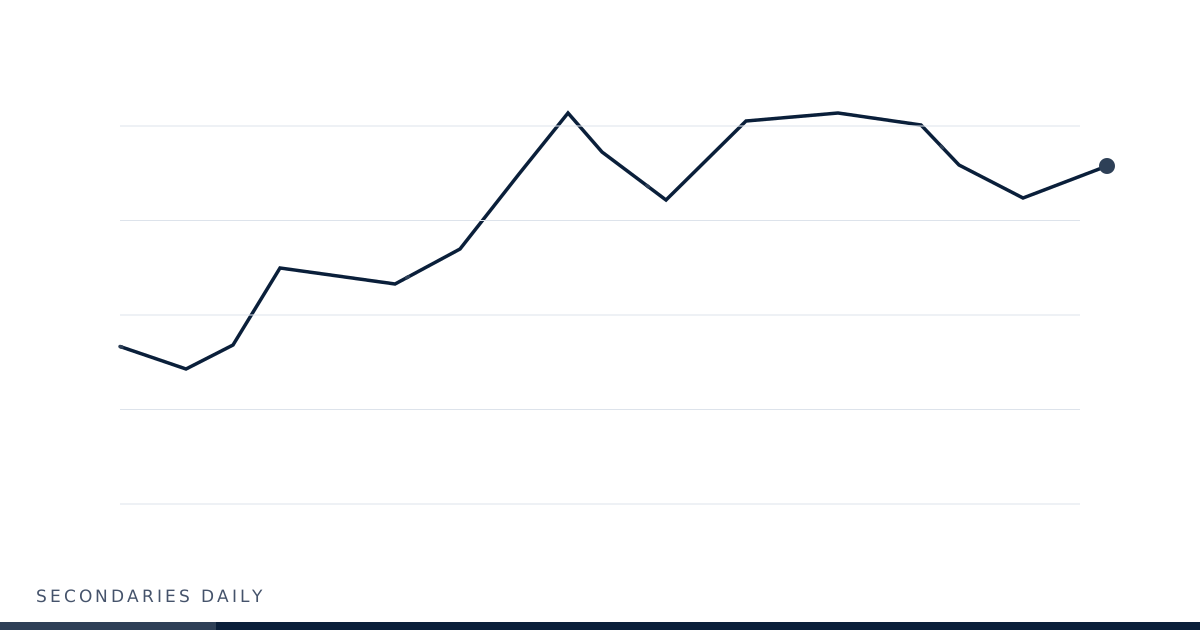
Forvis Mazars and PitchBook put the median EV/EBITDA multiple on private equity SaaS deals at 11.7x in the first half, down from 20.4x, across 702 transactions worth $58.8bn.

The median enterprise value-to-EBITDA multiple on private equity SaaS deals fell to 11.7x in the first half of 2026 from 20.4x, according to Forvis Mazars and PitchBook, erasing an 8.7-turn premium over six months and almost eliminating the advantage software businesses have long held over other sectors when sponsors bid for them. That leaves a published software comparable well below where the sector's recent underwriting sat, and it is now the benchmark any software-heavy continuation vehicle or LP-led book has to price against.
Ricardo Martinez, Forvis Mazars' national industry leader for technology and software, attributes the repricing to AI disruption risk, higher financing costs and a market that now weights profitability over growth, with investors putting greater weight on profitability, cash flow and competitive differentiation even as the premium that characterised software investing over the previous decade narrowed.
The repricing arrived in a thinner deal market: private equity investors completed 702 SaaS transactions worth $58.8bn in the first half, and the researchers point to a pullback in sponsor activity and fewer billion-dollar deals. The headline for software M&A overall tells a different story, as AI-driven strategic acquisitions pushed total global SaaS M&A value to a decade-high $439.7bn in the same period, a number heavily influenced by a relatively small set of very large deals.
Exits did not rescue the picture: the researchers estimated 1,458 global SaaS private equity and venture capital exits in the first half of 2026, against 1,652 for the whole of 2025, and they read the exit environment as substantially weaker than headline transaction values suggest once a handful of outsized deals are removed. Public markets offered a partial route, with 23 SaaS companies completing IPOs in the first half and mixed post-listing performance.
Underneath it sits the sector-wide capital-recycling problem: global private equity fundraising is on course for a third consecutive annual decline, industry dry powder has held around $4.4tn, and net cash flows have been negative since 2022, leaving managers carrying undeployed capital while distributions stay under pressure and limiting what flows back to LPs for new commitments.
Pricing a software book against 11.7x
For anyone marking a software-heavy portfolio, the Forvis Mazars and PitchBook median has the virtue of coming from completed sponsor deals dated to a half-year rather than from a GP's view of its own assets, and the limit that a median on control buyouts carries leverage, growth rates and EBITDA definitions the research as reported does not break out by vintage, fund or asset quality. A secondary buyer pricing an LP-led software book is underwriting a different population: minority positions in funds whose holdings mix the profitable with the not-yet-profitable.
Buyers and sellers now have an external, published comparable for software earnings sitting well below where the sector's recent underwriting did, and a rollover of a software asset is likely to be argued on how much of the gap is asset mix and how much is the market's view of the multiple itself. GP-led rollover has become private equity's default exit, and where the underlying asset is software, the price discovery inside that structure now has a benchmark to answer to.
The supply side has not moved with it: BDO's research, covered here in September, paired a longer tail of funds running past five years with sponsors telling surveyors they expect to buy at higher prices, and the pairing suggested LP-led books would price slowly rather than cheaply. A median of 11.7x on new software deals tests that optimism in a specific sector rather than in the aggregate.
The researchers also flag increasing scrutiny of the way software companies present the cost of AI investment, which is a disclosure argument now but lands on the denominator of every multiple in this story and on the assets a continuation vehicle has to price before an LP consents to the roll.
Save this analysis and keep the funds you follow together in My Desk.
Sign in to save articles or follow funds. Pricing & Data
SEC names funds in opening valuation requests
 The Wrap
Ibex closes $87m secondaries fund as three continuation vehicles close unpriced
 Fundraising